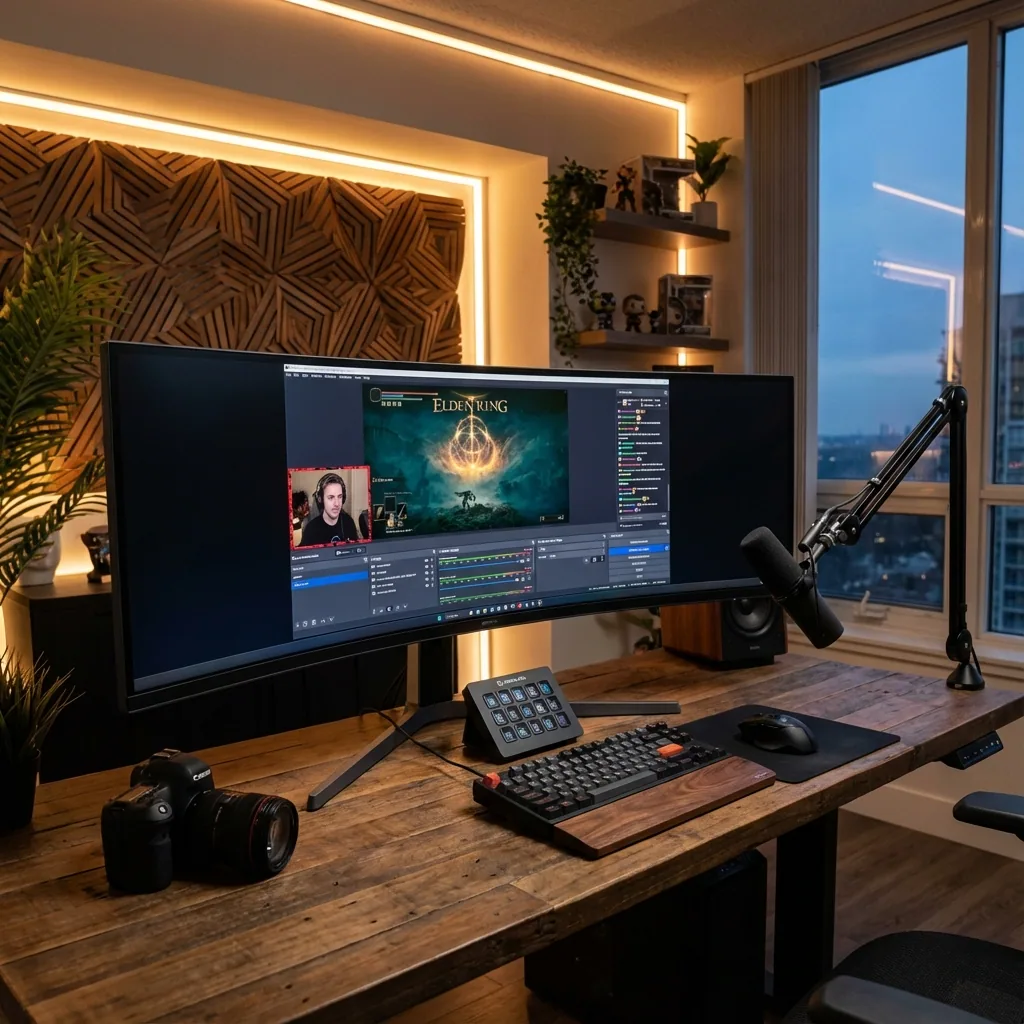
Streaming from an ultrawide monitor is both incredible and frustrating. The extra screen space is amazing for your workflow - Discord on one side, game in the middle, OBS preview on the other. But actually capturing JUST your game for your stream? That's where things get complicated.
I've spent way too many hours fighting with OBS, trying to capture my game without showing my entire 3440x1440 desktop (including the embarrassing Discord messages and Spotify playlists I definitely don't want viewers seeing). This guide is everything I wish someone had told me when I started streaming from ultrawide.
The Ultrawide Streaming Challenge
Here's the problem: most games on ultrawide displays run at 21:9 (3440x1440) or 32:9 (5120x1440). Your stream should be 16:9 (1920x1080).
If you use Display Capture in OBS, you're broadcasting your entire desktop - all 3440 pixels wide. Your actual game becomes a narrow strip in the center of the stream, with black bars on the sides. Or worse, your viewers see your Discord, browser tabs, and whatever else you have open.
The traditional solution is Game Capture in OBS, which hooks into the game process and captures just the game window. This works great... when it works. But ultrawide introduces complications:
- Many games don't trigger automatic Game Capture hooks
- Borderless windowed mode often fails to capture
- Some games render at weird resolutions that don't match their window
- Switching games requires reconfiguring capture sources
- Multi-monitor setups confuse OBS about which display to capture
Quick Answer: OBS Settings for 3440×1440 Ultrawide
For a standard 16:9 stream, avoid capturing the entire ultrawide desktop. Use Game Capture when the game is supported; otherwise capture a dedicated game window or a centered Game Stage and scale it to your stream canvas. The best starting point is a 2560×1440 Game Stage with a 1920×1080 OBS output: viewers get a clean frame while you keep chat and monitoring tools visible.
| Goal | OBS starting point |
|---|---|
| 3440×1440 monitor, 16:9 stream | Capture the game or centered 16:9 stage; output 1920×1080 |
| 5120×1440 monitor, 16:9 stream | Capture a centered 16:9 stage; keep side zones outside the capture |
| Full ultrawide broadcast | Match the canvas and output to the chosen ultrawide aspect ratio and confirm platform support |
With Staged, you get the best of both worlds: the game renders at the resolution you choose, your monitor keeps its own, and you can gain FPS while you stream — up to 2×, measured.
Traditional OBS Game Capture Methods
Method 1: Game Capture Source (The Standard Way)
This is the standard way to capture a game in OBS. When the game and capture mode are compatible, it produces a clean game-only source.
Setup:
- In OBS, add a new Source > Game Capture
- Name it something useful (I use the game name)
- Mode: "Capture specific window"
- Window: Select your game from the dropdown
- Check "Capture third-party overlays" if you want Discord overlay visible
- Click OK
The Good: When this works, you get clean game-only capture with zero desktop clutter. Performance impact is minimal. Automatic fullscreen detection.
The Bad: Only captures one specific game. Doesn't auto-switch when you change games. Some games (especially older titles or indie games) don't appear in the window list. Borderless windowed mode is hit-or-miss.
Ultrawide Specific Issues:
Your captured game is 21:9 or 32:9. Your stream canvas should be 16:9. You need to either:
- Crop the sides (losing peripheral vision areas)
- Scale to fit (creating letterboxing)
- Run the game at 16:9 in a window (defeats the purpose of ultrawide)
None of these are great options.
Method 2: Window Capture (The Fallback)
When Game Capture fails, Window Capture sometimes works.
Setup:
- Add Source > Window Capture
- Window: Select your game window
- Capture Method: Windows 10/11 (for better performance)
- Uncheck "Capture Cursor"
The Good: Works with more games than Game Capture. Can capture borderless windowed consistently.
The Bad: Captures window decorations unless you crop them. Performance hit is slightly worse than Game Capture. Can't capture true fullscreen (black screen issue).
Ultrawide Fix: Same aspect ratio problem as Game Capture. You're capturing 21:9 content for a 16:9 stream.
Method 3: Display Capture + Crop (The Desperate Approach)
This is what you do when nothing else works.
Setup:
- Add Source > Display Capture
- Select your primary display
- Right-click source > Transform > Edit Transform
- Crop pixels from left and right to get 16:9 ratio
The Good: Always works. No compatibility issues.
The Bad: Captures EVERYTHING on your display. Background apps, notifications, Discord messages, browser history, that embarrassing anime wallpaper. Also terrible for performance.
For Ultrawide: You're cropping a huge portion of your display. If you crop a 3440x1440 ultrawide to 16:9, you lose nearly 1000 pixels of horizontal space. That's almost half your screen gone.
Method 4: NDI + Separate PC (The Expensive Solution)
Some streamers run OBS on a second PC and send video via NDI (Network Device Interface).
Setup:
- Install NDI plugin on gaming PC
- Send game output via NDI
- Receive on streaming PC running OBS
- Encode and stream from the second PC
The Good: Zero performance impact on gaming PC. Can capture anything without desktop clutter.
The Bad: Requires a second PC. Network bandwidth intensive. Complex setup. Latency can be an issue.
This works great for professional streamers but is complete overkill for most people streaming from ultrawide.
The Zone-Based Capture Solution
Here's the approach that finally solved ultrawide streaming for me: dedicated zones.
The concept: create a Game Stage zone sized at 16:9 ratio where your game runs. The game thinks it's fullscreen (native performance, exclusive fullscreen benefits), but it's actually confined to a 16:9 zone in the center of your ultrawide.
Surrounding zones hold Discord, browser, OBS preview, stream chat - whatever you need visible while gaming.
Then in OBS, you capture JUST the Game Stage zone. Not your whole desktop. Not a specific game window. Just the dedicated gaming zone.
Why this is better:
- One capture source for all games - The zone doesn't care which game is running, it captures whatever is in that space
- Perfect 16:9 ratio - Your Game Stage IS 16:9, so your stream matches without cropping
- No desktop clutter - Apps in other zones aren't captured
- Works with any game - Fullscreen, borderless, windowed, doesn't matter
- Automatic game switching - Close one game, open another, capture keeps working
The tradeoff:
You're not using your full ultrawide resolution for gaming. A 2560x1440 Game Stage on a 3440x1440 ultrawide leaves ~440px on each side for other apps. But here's the thing: you weren't using that space in your stream anyway. At least now it's useful for Discord and monitoring stream health.
Setting Up Zone-Based Capture in OBS
Let me walk through the exact setup:
Step 1: Create Your Game Stage Zone
First, you need a zone-based layout. Using Staged (or any zone manager):
- Create a centered zone sized at 2560x1440 (16:9 ratio)
- This is your Game Stage where games will run
- Create additional zones for Discord, browser, etc.
- Save this as your "Streaming Layout"
Step 2: Configure OBS Canvas
- OBS Settings > Video
- Base Canvas Resolution: 2560x1440 (matches your Game Stage)
- Output Resolution: 1920x1080 (your stream resolution)
- Downscale Filter: Lanczos (best quality)
- FPS: 60 (or 30 for slower-paced games)
Step 3: Add Window Capture for Game Stage
Here's the key part:
- In OBS, add Source > Window Capture
- Window: Select the window currently in your Game Stage
- Capture Method: Windows 10/11
- This captures just that window, not your whole desktop
OR if using Staged's Game Stage capture:
- Add Source > Window Capture
- Window: "[STAGED-GAME-STAGE]"
- This automatically captures whatever game is running in the Game Stage zone
Step 4: Size and Position
Your captured source should exactly fill your OBS canvas:
- Right-click source > Transform > Fit to Screen
- That's it - 2560x1440 game capture fits perfectly in 2560x1440 canvas
- OBS downscales to 1080p for streaming
Step 5: Add Overlays
Now you can add stream overlays on top:
- Webcam source (positioned in corner)
- Alert boxes
- Chat widget
- Recent follower notifications
- Stream labels
These overlay on top of your game capture without covering Discord or other apps in the side zones.
Audio Routing for Zone Captures
Here's a pro tip: you probably don't want Discord audio in your stream (unless you have permission from everyone in voice chat).
Windows Audio Setup:
- Right-click Volume icon > Sounds > Advanced
- Game audio > Default Device
- Discord > Secondary audio device (or use Discord's own output device selection)
OBS Audio Setup:
- Settings > Audio
- Desktop Audio: Your default device (captures game audio)
- Don't add your secondary audio device (Discord won't be captured)
This way your game audio goes to stream, Discord stays private, but you hear both in your headset.
Alternative: Use Voicemeeter Banana for advanced audio routing. It's free and gives you total control over what audio goes where. Great for streaming but has a learning curve.
Step-by-Step: Perfect Ultrawide Stream Setup
Let me give you the complete workflow I use:
Pre-Stream Setup
1. Launch zone manager and load Streaming Layout
- Game Stage: 2560x1440 centered
- Discord zone: 440x1440 left side
- OBS Preview zone: 440x1440 right side
2. Open apps in their zones
- Launch Discord, drag to Discord zone
- Launch OBS, drag preview to OBS zone
- Launch browser for stream dashboard in spare space
3. Configure OBS (one-time setup)
- Canvas: 2560x1440
- Output: 1920x1080, 6000 bitrate, x264 or NVENC
- Window Capture source for Game Stage
- Webcam source
- Alerts and overlays
Live Streaming
1. Launch game
- Game automatically opens in Game Stage zone
- Appears instantly in OBS preview (already capturing)
- No need to reconfigure OBS
2. Verify capture
- Check OBS preview in your OBS zone
- Make sure game is captured, overlays visible
- Audio meters showing game sound only
3. Start streaming
- Click "Start Streaming" in OBS
- Monitor stream health in OBS preview zone
- Chat with Discord in the Discord zone while gaming
4. Switch games
- Close current game
- Launch new game - opens in Game Stage automatically
- OBS keeps capturing without any changes
This workflow is why I love zone-based streaming. Everything just stays where it should be, and OBS never loses the capture.
Advanced OBS Settings for Ultrawide Streaming
Encoder Settings
For NVENC (Nvidia GPU encoding):
- Encoder: NVENC H.264
- Rate Control: CBR
- Bitrate: 6000 kbps for 1080p60
- Preset: Quality (or P5 on newer drivers)
- Profile: High
- Look-ahead: Unchecked (causes latency)
- Psycho Visual Tuning: Checked
For x264 (CPU encoding):
- Encoder: x264
- Rate Control: CBR
- Bitrate: 6000 kbps
- CPU Preset: veryfast (or faster if CPU usage too high)
- Profile: high
NVENC is preferred for gaming streams because it doesn't hurt game performance. x264 gives slightly better quality but can tank your framerate if your CPU is already maxed.
Downscale Filtering
When going from 1440p Game Stage to 1080p stream:
- Lanczos: Best quality, most GPU intensive (use this)
- Bicubic: Good balance of quality and performance
- Bilinear: Fastest but can look soft
Unless you're really struggling with encoding performance, use Lanczos. The quality difference is noticeable.
Recording While Streaming
Record at higher quality than you stream:
- Settings > Output > Recording
- Type: Standard
- Recording Format: mkv (safer than mp4)
- Encoder: Use stream encoder or NVENC for separate track
- Important: Set recording resolution to match your Game Stage (2560x1440)
This way you have high-quality footage for YouTube uploads while streaming at 1080p to Twitch.
Common OBS Ultrawide Issues (And Fixes)
"Game Capture shows black screen"
Game is likely running in exclusive fullscreen on wrong GPU or incompatible anti-cheat. Solutions:
- Run OBS as administrator
- Try Window Capture instead
- Check that OBS and game are using the same GPU (if you have multiple)
- Some games block OBS capture entirely (Valorant, Fortnite with anti-cheat)
"Captured game is stretched/squished"
Aspect ratio mismatch. Right-click source > Transform > check "Bounding Box Type" is set to "No Bounds" and aspect ratio matches game output.
"Performance tanks when OBS is running"
- Switch to NVENC encoding if using x264
- Lower OBS canvas resolution
- Cap in-game FPS to reduce total system load
- Close Chrome (seriously, it eats resources)
"Stream looks pixelated during fast motion"
Bitrate too low for 1080p60. Increase to 6000 kbps minimum. If still pixelated, consider streaming 1080p30 or 900p60 instead.
"Audio out of sync with video"
Check Settings > Advanced > Video > Rendering Lag. Also verify audio devices are set to matching sample rates (48kHz recommended).
"Capture keeps losing the game when I Alt-Tab"
Window Capture can lose focus on Alt-Tab. Use Game Capture instead, or switch to zone-based capture which doesn't care about window focus.
Ultrawide Streaming Layouts That Work
Here are proven layouts for different ultrawide sizes:
21:9 Ultrawide (3440x1440) - Standard
- Game Stage: 2560x1440 (16:9) centered
- Left Zone: 440x1440 (Discord/Chat)
- Right Zone: 440x1440 (OBS Preview/Browser)
21:9 Ultrawide (3440x1440) - Minimalist
- Game Stage: 2880x1620 (16:9) centered
- Thin zones on sides for Discord/OBS just visible
32:9 Super Ultrawide (5120x1440)
- Game Stage: 2560x1440 (16:9) centered
- Left Zone 1: 640x1440 (Stream chat/alerts dashboard)
- Left Zone 2: 640x1440 (Discord)
- Right Zone 1: 640x1440 (OBS Preview)
- Right Zone 2: 640x1440 (Browser/Spotify)
The 32:9 layout is incredible for streaming. You have SO much space for monitoring tools while your game gets a perfect 16:9 capture zone.
Multi-Monitor Streaming Alternative
Not ready to commit to zone-based layouts? The classic alternative is a second monitor.
Setup:
- Ultrawide for gaming at native resolution
- Second 16:9 monitor for OBS, Discord, stream dashboard
- Use Display Capture on the ultrawide, cropped to 16:9 center
- Or use Game Capture as normal
Pros: Game uses full ultrawide, monitoring tools on second display Cons: Need desk space, more expensive, neck strain from looking left/right
Honestly? I prefer zones on a single ultrawide over multi-monitor. Having everything in peripheral vision without turning my head is way better for stream monitoring.
Frequently Asked Questions
Can I stream at 21:9 ultrawide aspect ratio?
Yes, but viewers on 16:9 screens may see black bars or a reduced game area. For broad compatibility, capture a centered 16:9 game frame and output at 1920×1080; use an ultrawide output only when the platform and audience support it.
Does using zones hurt game performance?
Staged uses direct hardware scanout on Windows 11 with zero compositor overhead, measured. It adds under 0.2 ms of processing overhead, and the stage shows the same frame as the game in measured samples. Your complete result still depends on the game, GPU, and display.
What if I want to show my full ultrawide occasionally?
Create a second OBS scene with Display Capture of your full ultrawide. Switch to it when you want to show desktop, browsing, etc. Most of the time you'll use the Game Stage scene for actual gameplay.
Is Staged available for streaming?
Check the current availability and license terms on the official features page.
Can I use this method with Streamlabs OBS?
Yes. The zone-based capture concept works with any streaming software that can capture specific windows or regions. Streamlabs, native OBS, XSplit - all compatible.
Streaming from ultrawide doesn't mean choosing between a cluttered desktop capture and weak performance. Staged gives you a clean 16:9 game capture, visible Discord and monitoring tools, and a measured path to gain FPS while you stream.
Once the layout is tested, you can reuse the same OBS scene while switching games. Capture behavior still depends on the game, window mode, and OBS source.
For an ultrawide or super ultrawide setup, this is the best workflow: combine the capture method, audio routing, and zone layout that work on your hardware.
Ready to simplify your streaming setup? Check out Staged for zone-based display management built specifically for ultrawide gaming and streaming.